• Autonomous Vehicles: Sensors and Safety
• Sensor Tip: Touchless or Shaft Angle Sensor Tech for Your Application
• Application: Paper Cutting Machine
• and more. |
|---|
To view newsletter in your browser click here.
|
|---|
|
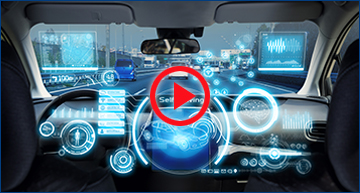
Advanced Autonomous Vehicle Cockpit (Stock Photo)
|
|---|
| | | |
| | | |
| | | |
Autonomous Vehicles: Sensors and Safety
Autonomous vehicles (AVs) typically use two or more types of sensors to gather the information necessary to automate the driving of a vehicle. These sensor categories are light detection and ranging (LiDAR), radio detection and ranging (Radar), cameras, ultrasound, GPS and, inertial measurement unit (IMU) including, should it go on the market, Inertia Micro’s MEMS resonator-based gyroscope for ultra-high accurate positioning that was described in our Winter 2024 newsletter. There are informative tables in sources 1and 2 comparing sensor range, accuracy and a comparison of sensor technology used by common AV manufacturers. The Society of Automotive Engineers has ranked the levels of AV automation from 0 (none) to 5 (full driving automation), with partial automation increasing from level 2 to 4.
These sensors are used for detecting objects, determining traffic signal presence and color, measuring the distance and speed of objects around the vehicle, detecting edges of obstacles and the position of the vehicle itself. Additionally, sensors found on most any modern vehicle that are needed for proper vehicle function include steering position, throttle position and gear selector position. The reliability and accuracy of these sensors are vital for safety and functionality.
Safety of AVs is of paramount concern. So, what is their safety record? A study pulled “data on 2100 accidents from California and the National Highway Traffic Safety Administration (NHTSA) involving vehicles equipped with some level of automated self-driving or driver assistance technologies. They also gathered data on more than 35,000 accidents involving unassisted human drivers."3 The study authors went on to conclude with limited data, “The overall results suggest autonomous vehicles “generally demonstrate better safety in most scenarios,” says Abdel-Aty. But the analysis also found self-driving cars had a crash risk five times as great as human drivers when operating at dawn and dusk, along with almost double the accident rate of human drivers when making turns.”
Add to this the likelihood that “outward facing” sensors and cameras will be impeded by severe weather conditions of rain and snow which could affect safety. Plus how infrequent events such as another vehicle running a red light or a person not paying attention and stepping in front of a moving car are handled by AV software versus a human can be very important.
Sensor reliability would seem vital and one way to measure that is in number of vehicles and years in those vehicles a sensor has been in use. If you will pardon us making an editorial exception one time and touting it, over 50 million vehicles have Novotechnik automotive sensors in them.
How about new strategies and applying AI to AVs? One company, Wayze, seems to have gone further than others in this regard. They are applying a layered approach to AV control that includes “generative AI models,” applying real driving data to simulations and testing, as well as real driver language describing their actions to integrate human situational thinking into their AI model. According to the company, all this together let’s them predict the next action by a human driver in their automation.4, 5
|
|---|
| | | |
 |
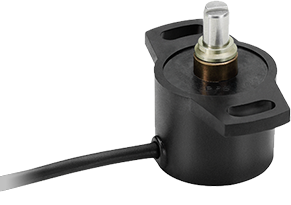
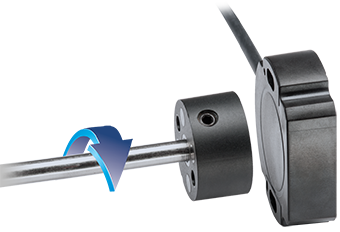
Touchless or Shaft Angle Sensor — Which Is Best for Your Application?
Applications that benefit from use of a shaft-type sensor
• Applications in which a dancer arm is being used to measure tension of a wire or foil or fabric in a production machine and there is no other shaft available.
• Applications where the sensor needs to be part of a gear box or geared actuator and has a gear on its shaft. |
|---|
|
| | | |
• When replacing a contacting potentiometer type or RVDT-type sensor that had a shaft of same size.
• When the measurement site is very far from where the sensor can be mounted due to design considerations such as extreme heat.
Applications that benefit from a touchless sensor
• Applications where an angle measurement is made through the enclosure or machine wall
• Applications seeking an IP69K sealed sensor
• When no sensor wear is desired
• Applications that have ultra-high vibration of the rotating shaft
• When a small radial misalignment of the applications rotating shaft may occur
|
|---|
• Completely enclosed magnet and sensor for superior sealing properties
• No wear because no contact
• No mechanical coupling is needed
• Vibration from drive shaft / magnet marker does not get transferred to sensor providing maximum robustness
• Flexible mounting of sensor on front or on back of a mounting plate
• Can measure through non-magnetic walls <1/4”. |
|---|
|
| | | |
| | | |
|
|
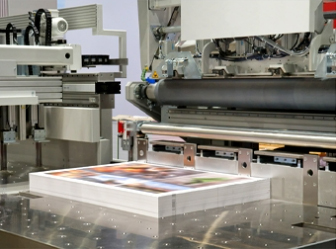
A manufacturer of paper cutting machines used primarily in the printing industry needed a highly accurate position sensor.
Novotechnik's TLM position sensor measures and sends the precise position of the cutting blade to the machine’s PLC for reliable and accurate control of each cut. Novotechnik has since introduced a newer technology product that is more accurate and with faster speed as an upgrade. This product is the TF1 Series.
Learn more. |
|---|
| | | |
| | | |
| |
| Please email suggestions for technical subjects you would like to suggest for this newsletter to this link: Newsletter Editor |
|---|
| | | | |
| |
|